Temporal Nexus - Temporal feature
Temporal Nexus is now Generally Available for Temporal Cloud and self-hosted deployments.
As Temporal adoption grows across teams, organizations partition their applications into isolated Namespaces for security and fault isolation. Nexus bridges these boundaries, connecting Temporal applications across Namespaces, regions, and clouds with built-in durable execution, observability, and access control. Each team retains ownership of their own Namespace while sharing capabilities through clean service contracts. Watch the Nexus overview for a walkthrough.
Before Nexus
Connecting Namespaces was possible, but painful. It required extensive configuration, added operational overhead, and often depended on additional infrastructure
- Child Workflows - Limited to the same Namespace. Cross-Namespace use leaks underlying implementation details, requiring callers to manage the target Namespace, Task Queue, and Workflow options.
- Activity wrappers - Require per-target mTLS clients, adding configuration and certificate management overhead. Often over-permissioned, lack built-in observability, and require error-prone boilerplate for async results.
- Extra gateway infrastructure - Not durable, difficult to debug across services, and adds another service to manage and patch.
Nexus replaces all of these with a clean service contract between caller and handler, reducing code, and providing first-class observability.
Benefits
Connect Temporal Applications across teams, domains, regions, and clouds with:
- Stronger security posture - Built-in access controls for service contracts instead of broad Namespace access. Each team controls their own Namespace, Workers, and deployment lifecycle.
- Higher reliability - Durable, atomic handoffs eliminate lost requests. Faults are isolated so misbehaving Workers don't impact other teams.
- Easier to build and maintain - Less boilerplate code, custom retry and deduplication logic, and ongoing maintenance. Teams focus on business logic instead of infrastructure.
- Scalable platform patterns - Enables cross-team and cross-region orchestration without centralizing ownership.
- Lower barriers to cross-team use cases - Makes it easy to incrementally build and adopt shared services, with built-in discoverability.
- Compliance and data isolation - Isolated Namespaces support auditability, data residency requirements, and dedicated encryption and access controls for sensitive data (PCI, PII).
What customers are using Nexus for
- Duolingo - Self-service infrastructure (Case study | Webinar)
- Netflix - Infrastructure orchestration (Replay talk | Webinar)
- Miro - Cross-region data migration (Replay talk)
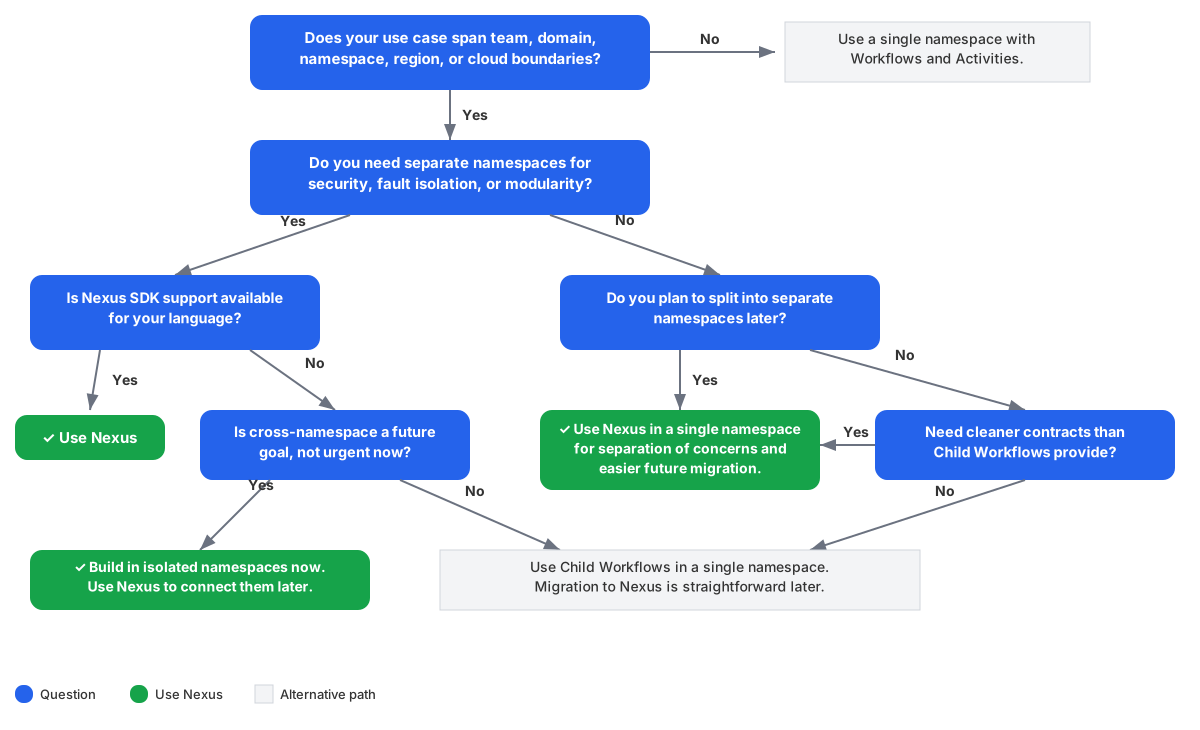
Should I use Nexus?
Use the following decision tree to help determine if Nexus is right for your use case:
Get started
Join the #nexus channel in Temporal Slack to connect with the Nexus community.
 Nexus concepts and architectureencyclopedia
 Go SDK - Nexus quick startfeature-guide
 Java SDK - Nexus quick startfeature-guide
 Python SDK - Nexus quick startfeature-guide
 TypeScript SDK - Nexus quick startfeature-guide
 .NET SDK - Nexus quick startfeature-guide
- Temporal Cloudfeature-guide
- Self-hosted deploymentfeature-guide